

Our Process
Every step, from design to delivery, is handled in-house.
01
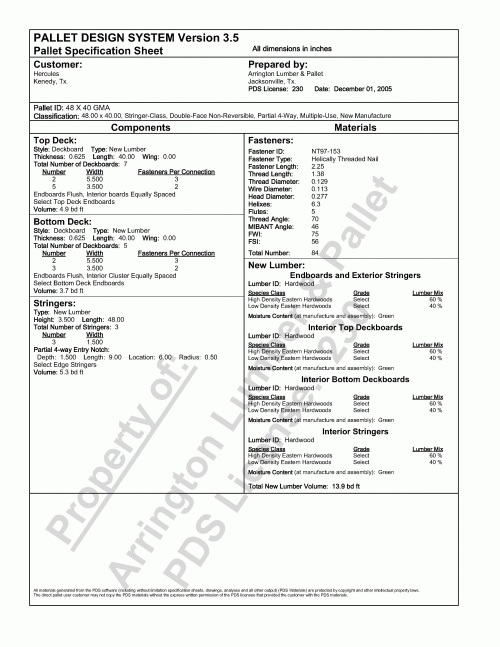
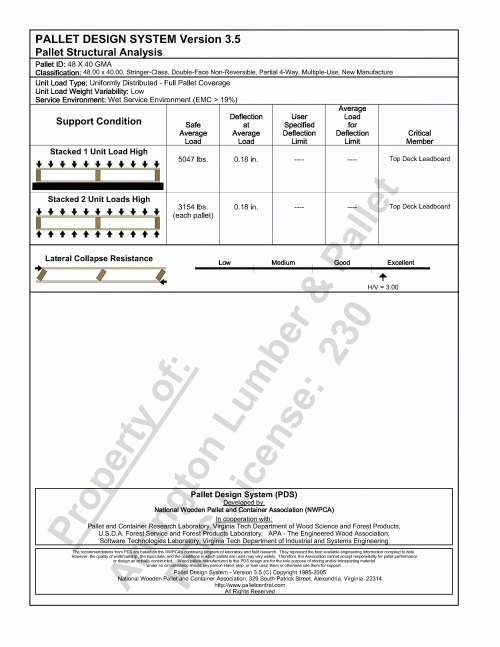
We design pallets using the Pallet Design System© (PDS), an engineering tool built on decades of laboratory research and field testing by NWPCA and the William H. Sardo, Jr. Pallet & Container Research Lab at Virginia Tech. PDS© simulates pallet strength, stiffness, and life-cycle performance based on real-world material-handling conditions. It has been in use since 1984 and is used by manufacturers in 15 countries.
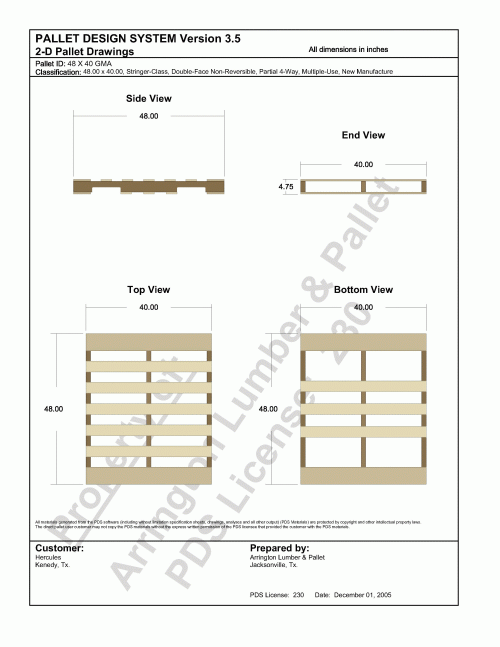
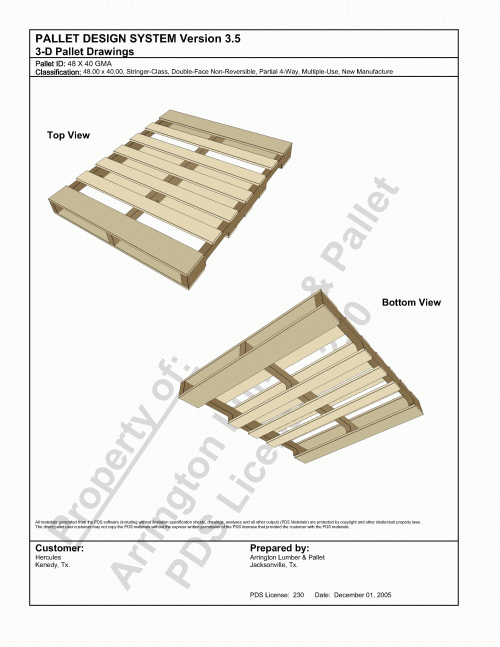
A pallet’s strength and durability depend on the thickness, size, and number of its deck and stringer boards, as well as board placement, notching, chamfering, and clipping. PDS© lets us engineer a pallet for what it will carry, whether that’s boxes, bags, or bulk product.
The images to the right show sample output from the PDS© program. Contact us to have a pallet designed for your load.
02
East Texas sits in what locals call the “Pine Curtain,” one of the densest concentrations of forestland in the South. Timber is close and supply is consistent, and we’ve been buying and milling timber in this region for more than sixty years.
Most pallets are built from pine, and so are ours. Between green and kiln-dried pine we can meet nearly any customer’s needs, and we choose the lumber for each order based on the application and on keeping the customer’s costs stable over time.
Our four sawmills are set up to adjust to the timber available and the orders on hand. A pallet manufacturer that buys its lumber from others doesn’t have that flexibility.
Because we sell several products, we can buy timber in markets that single-product operations can’t. That keeps us supplied when timber is scarce, which keeps our customers supplied as well.
In the early 1990s, we switched to thin-kerf bandsaws. The thinner blade saved enough material on each cut to get an extra board out of the same log.
03
Our production capacity.
6
Nailing Machines
4
Sawmills
9
Cut-Up Saw Lines
25+
Trucks in Fleet
Our customers depend on steady supply, and we’ve built the operation with enough capacity to fill large orders on schedule.
We’re a SPEQ-certified vendor and an active NWPCA member. In 2022 we rebuilt the cut-up department around integrated end-to-end lines, which reduced labor costs and increased throughput.
Our six Viking nailing machines are computer-driven in both parameter and production mode, and build 3-, 4-, and 5-stringer pallets quickly and accurately. We’ve run Viking machines for more than 20 years.
In 2026 we installed a boiler that burns sawdust from our mills to supply heat for heat treating and other drying processes. Improvements like this lower our operating costs, which helps us keep our prices competitive.
Step 04 →
Heat treating for export shipments.
04
Export wood packaging has required heat treatment since the European Union’s Emergency Measures took effect in October 2001. Those measures mandated that coniferous wood packaging reach a minimum core temperature of 56°C for 30 minutes — killing insects in and on the wood before it crosses a border.
Around the same time, the International Plant Protection Convention developed ISPM 15 — the international standard for regulating wood packaging in trade. ISPM 15 requires the same 56°C/30-minute treatment regardless of species and is available for adoption by any country as its import standard.
Arrington Lumber & Pallet Co. is fully qualified to provide heat-treated pallets. We are inspected by Timber Products Inspection and are in good standing with the IPPC. We can supply compliant pallets for your export shipments.
Countries that have adopted ISPM 15
Heat-treated pallets carry the IPPC mark, the stamp that shows customs inspectors the wood was properly treated. Every pallet we build for export has it stamped on the stringer.
Step 05
Mold Prevention
05
When heat-treated pallets first entered the export market, packaging manufacturers along the Gulf Coast ran into an unexpected problem. The combination of high humidity, high heat, and low sunlight in this region creates ideal conditions for mold growth on heat-treated wood.
Heat treatment kills insects, but it also draws natural sugars to the surface of the wood, and mold feeds on those sugars. The mold is harmless but undesirable. It can be cleaned off with high-pressure water or diluted bleach, but it returns quickly. Preventing it requires a longer-lasting treatment.
We developed our mold-prevention process over several years of testing. Each pallet is treated as a whole unit after it is built and heat treated, covering 99.9% of the surface and penetrating up to ¼ inch into the wood. We believe it is the most effective method available, and our results have borne that out.
99.9%
Surface area coverage
Every pallet treated as a whole unit after build and heat treating.
¼”
Penetration depth
The treatment penetrates the wood as well as coating the surface.
Why it matters on the Gulf Coast
The region’s humidity, heat, and limited sunlight make heat-treated pallets especially prone to mold.
Step 06
06
We run our own fleet of tractor-trailers, maintained by on-site mechanics with support from our truck supplier. Running our own trucks means we don’t depend on outside carriers to make deliveries on time.
Jacksonville is within one-day delivery distance of five major Southern cities, so we can serve customers with multiple facilities across the region. Our current customers are in Texas, Arkansas, Oklahoma, and Louisiana.
One-day reach from Jacksonville, TX
Send us your specifications or your requirements, and we’ll prepare a quote.
Get in Touch →